CASE STUDY: Moodoodle
SELF-INITIATED CONCEPT PROJECT
Moodoodle is a concept mobile app designed to help children identify, understand, and manage their emotions through play. It was born directly from nine years of teaching experience — watching traditional emotional learning methods fail to engage kids in any meaningful way. This is a self-initiated UX/UI design project, with an interactive Figma prototype available to view above.

RESEARCH
Research drew heavily on classroom experience and child development principles — understanding how children process and express emotion at different ages, what keeps them engaged, and where existing tools fell short. I looked at children's apps, educational psychology resources, and existing emotional learning tools to identify the gaps Moodoodle could fill. The key insight: most emotion apps for kids are either too clinical or too passive. Moodoodle needed to be genuinely interactive and visually expressive.
DESIGN
Nine years in the classroom shaped every design decision. Children engage through play, not instruction — so the entire app is built around interactive activities rather than passive lessons. The visual system uses two contrasting themes: one bright and energetic for positive, high-energy emotions, and one softer and calmer for difficult or overwhelming feelings. The dual-theme approach gives children an immediate visual language for their emotional state before they have the words to describe it.
KEY AUDIT INSIGHTS
The design audit evaluated three core areas: clarity of navigation for young users who can't rely on reading, effectiveness of the visual emotion system, and whether the difficulty curve kept kids engaged without becoming discouraging. The goal was an experience that felt intuitive enough for a six-year-old but expressive enough for a ten-year-old.
CHALLENGES
The core design challenge was balancing simplicity with depth — the app needed to feel immediately playful and accessible, but not so shallow that it failed to actually teach anything meaningful. A second challenge was designing for a non-reading audience: navigation, emotion labels, and instructions all had to work through visuals and iconography alone, without relying on text to guide the experience.
WIREFRAMING & PROTOTYPING
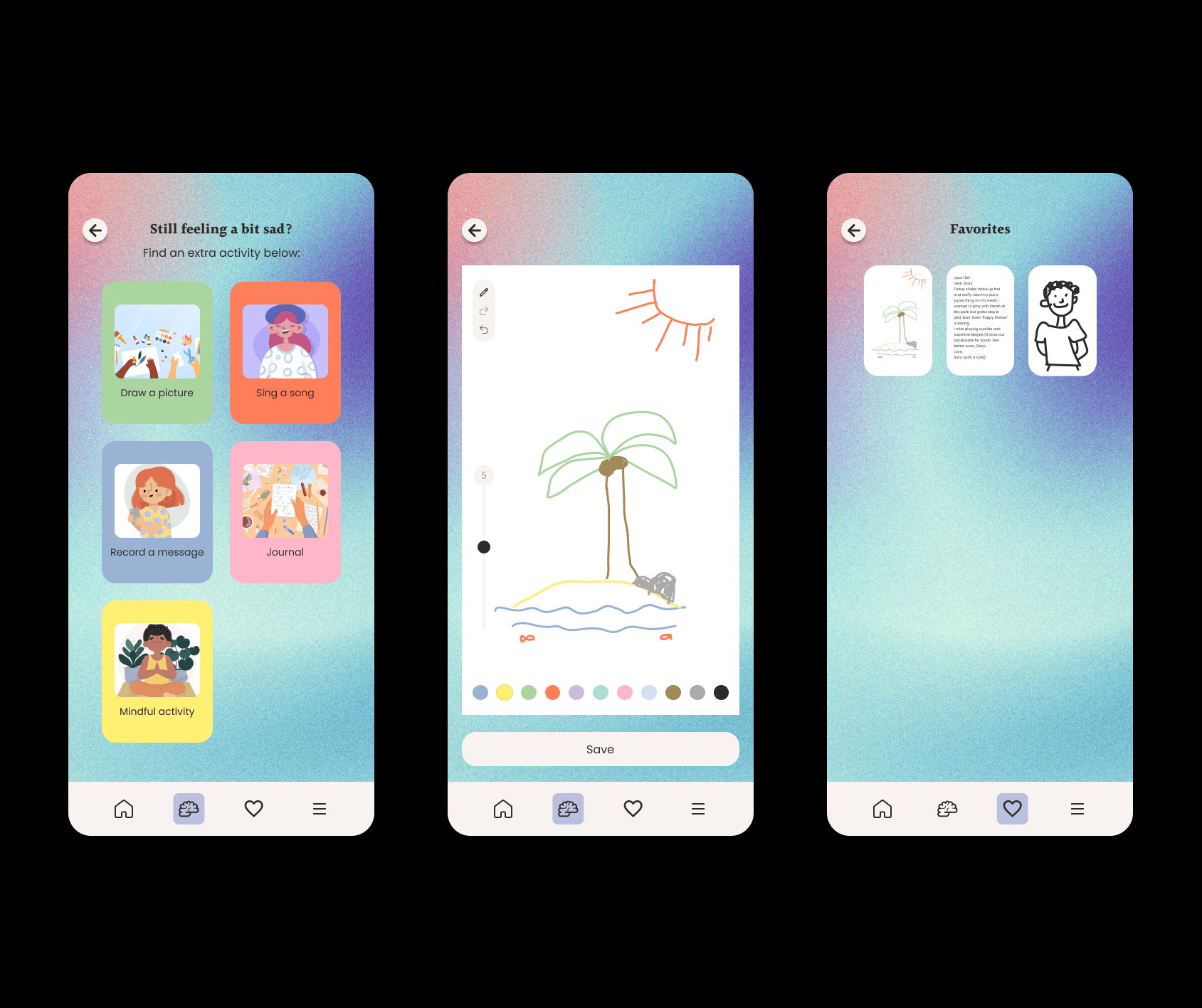
Wireframes mapped the app's structure and navigation flow, prioritising the icon-led interface that young users would need to navigate independently. High-fidelity prototypes in Figma refined the interactions, visual hierarchy, and emotional activity flows — with the dual-theme system tested across both light and dark emotional contexts.

USER EXPERIENCE
Every interaction is designed for a child navigating independently — large touch targets, icon-led navigation with no reliance on reading ability, and a calm visual environment that doesn't add to emotional overwhelm. The app also accounts for introverted or non-verbal children, offering alternative ways to express and communicate feelings beyond spoken or written language.

SUMMARY
Moodoodle is a concept project that draws directly on teaching experience to solve a real problem — children lacking the tools to understand and express their emotions. The project demonstrates a full UX process applied to a complex, non-standard audience: research, audit, dual-theme visual system, icon-led navigation design, and interactive Figma prototype. The interactive prototype is available via the link at the top of this page.
